
 Facebook
 X
 Pinterest
 Copy Link
November 2, 2026 | Windermere Real Estate/SV, LLC
I spent a good chunk of last week in San Diego with a group of Windermere owners from around the country. We shared ideas, learned from one another, had some good laughs, and inevitably spent a fair amount of time talking about the state of the real estate industry.
And what a state it’s in.
Here in Sun Valley, we often joke about living in a bubble. It’s one of the things we love about this place. But when it comes to real estate, I realized last week that I’ve been following some pretty significant industry developments from comfortably inside that bubble.
Over the past year, my inbox has been filling up with headlines about mergers, acquisitions, lawsuits, and regulatory investigations. I’ve been paying attention, but hearing other brokerage owners talk through what’s happening across the country was eye-opening.
One topic kept coming up: Compass.
And the recurring sentiment was that everything is moving so quickly, it’s hard to keep up.
So I decided to do a little digging myself. Not an exhaustive investigation by any means, but enough to better understand how we got here and why so many people in our industry are paying attention.
The more I looked, the more I found myself thinking about something much bigger than real estate.
First, What Actually Happened?
If you haven’t been following the story, here’s the condensed version.
In January 2025, Compass completed its acquisition of the business holding the rights to operate and license the Christie’s International Real Estate brand.
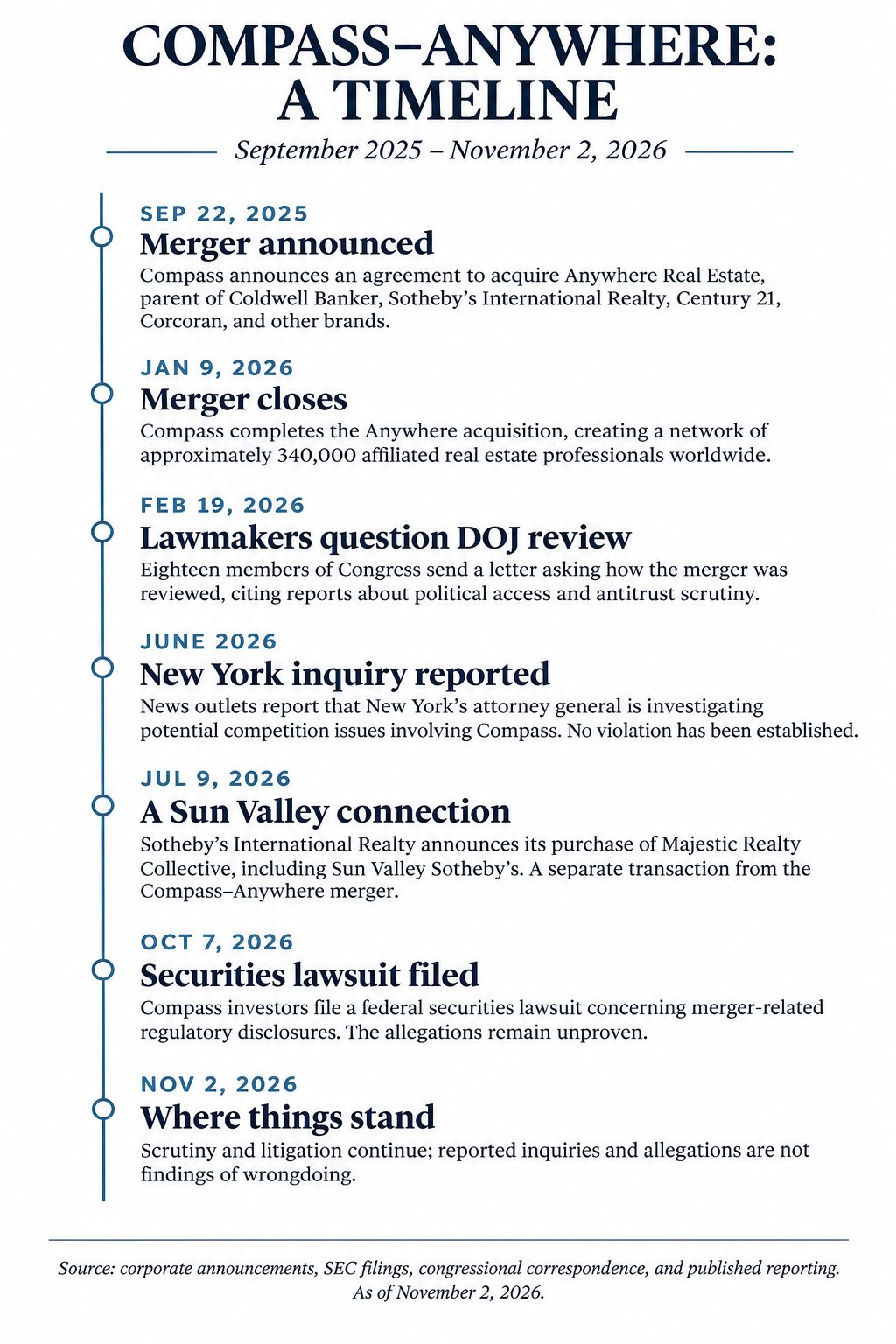
Then, on September 22, 2025, Compass announced an agreement to acquire Anywhere Real Estate, the parent company of some of the industry’s most recognizable brands, including Coldwell Banker, Sotheby’s International Realty, Century 21, and Corcoran.
The Compass–Anywhere merger closed on January 9, 2026.
The resulting organization, Compass International Holdings, represents a network of more than 340,000 affiliated real estate professionals worldwide, including agents working at independently owned franchise offices.
That’s an enormous amount of consolidation in a relatively short period of time.
And I want to be clear about something: Growth isn’t inherently bad. Neither are mergers.
There’s a very reasonable argument that combining companies can create efficiencies, improve technology, reduce duplication, and ultimately provide better services to agents and consumers.
Compass has made that case, and I think it deserves consideration.
But consolidation on this scale also raises some fair questions.
What happens to competition when so many prominent brands are owned by the same parent company? Do consumers ultimately benefit from the efficiencies, or could they eventually face fewer choices? What happens to independent brokerages if one company controls an increasingly large share of the market?
I don’t pretend to have all those answers. Nor do I pretend that it’s easy to follow, with that in mind, there’s a visual timeline at the bottom of this post.
But I do think they’re questions worth asking.
Where the Story Gets More Interesting
Here’s the part that really caught my attention.
According to reporting by Bloomberg and The Wall Street Journal, Justice Department antitrust officials wanted to conduct a more extensive investigation of the Compass–Anywhere merger.
Compass had retained attorney Mike Davis, who has political connections to President Trump, to assist with the regulatory process. Reporting indicates that Davis advocated against an extended review with senior Justice Department officials, above the agency’s antitrust leadership.
Ultimately, the federal antitrust waiting period expired without the extended investigation staff had reportedly sought, allowing the merger to close considerably sooner than originally expected.
Now, there’s an important distinction here.
Companies have every right to hire experienced attorneys and advocate for their interests. Senior Justice Department officials also have the authority to make enforcement decisions.
And the fact that a merger closes without an extended investigation does not, by itself, establish that anything improper occurred.
But the reported circumstances have prompted questions.
In February, 18 members of Congress wrote to Attorney General Pam Bondi seeking information about how the merger was reviewed and whether political influence affected that process.
In June, news organizations reported that the New York Attorney General’s office was conducting an antitrust inquiry into Compass’s expanded presence in the New York real estate market.
One reason New York has attracted particular attention is the concentration of brokerage business involved. An analysis reported by The Capitol Forum estimated that Compass and Anywhere together accounted for more than 80% of Manhattan residential brokerage sales volume within the dataset examined, using 2024 figures. That’s not a verified market share of every transaction in Manhattan, but it helps illustrate why the scale of the merger has raised questions.
Then, in October, former Anywhere shareholders filed a federal securities lawsuit alleging that certain disclosures surrounding the merger’s regulatory review were misleading.
These are allegations and reported investigations, not findings of wrongdoing. The shareholder claims remain unproven, and the New York Attorney General’s office has not publicly released findings establishing an antitrust violation.
Still, it’s a lot to absorb.
And what I find most interesting isn’t necessarily whether this particular merger should or shouldn’t have happened.
It’s whether the process used to evaluate it was thorough, fair, and independent.
Why the Process Matters as Much as the Outcome
I have no problem with a company becoming successful. In fact, I admire businesses that find ways to innovate, grow, and improve their industries.
But I also believe that when a merger has the potential to significantly alter competition, it deserves careful scrutiny.
Not because the government should automatically stand in the way of large companies, but because it has a responsibility to consider the interests of consumers and the broader marketplace.
My concern is the precedent we could inadvertently create.
If the perception takes hold that companies can fast-track major mergers or other consequential decisions by finding the right connections rather than going through a consistent review process, what does that mean for the next merger? Or the one after that?
Even the appearance of preferential treatment can undermine confidence in the system.
And while this particular story happens to involve real estate, the same questions apply to healthcare, technology, banking, agriculture, and countless other industries.
I don’t think this needs to be a partisan issue.
Whether a Republican or Democrat occupies the White House, the rules should be applied fairly. A company’s political relationships shouldn’t determine how carefully its business decisions are examined.
To be clear, I am not suggesting it has been established that Compass received improper treatment. I’m saying the reported concerns deserve transparent answers, and that maintaining confidence in the review process matters regardless of the eventual conclusions.
If a merger is good for consumers and competition, a thorough review should help demonstrate that.
And if it presents meaningful risks, we should want those risks identified before they become difficult to undo.
What Does Any of This Have to Do with Sun Valley?
More than you might think.
On July 9, Sotheby’s International Realty announced its acquisition of Majestic Realty Collective, a group of luxury brokerages that included Sun Valley Sotheby’s International Realty.
That transaction brought our local Sotheby’s operation into the corporate-owned network of a company now within Compass International Holdings. In simpler terms, Compass Corporate owns Sothebys Copoarate, which now owns our
It’s a separate acquisition from the Compass–Anywhere merger and isn’t implicated in the allegations surrounding the federal review.
But it is an example of how these national changes can eventually reach our own little valley.
As the owner of a locally based brokerage, I naturally pay attention to what consolidation means for independent businesses. I have a stake in this industry, and I think it’s important to acknowledge that perspective.
But what I care about most isn’t simply preserving independent brokerages for their own sake.
It’s preserving a healthy marketplace.
I genuinely love working in real estate in Sun Valley. And while the beautiful homes and incredible surroundings are certainly a perk, they’re not the biggest reason.
It’s the people.
Some of the people I most enjoy working with in this business are agents at competing brokerages. We compete hard for business, but we also work together to solve problems, get transactions across the finish line, and take care of the buyers and sellers who trust us.
There’s a tremendous amount of professionalism and mutual respect in our local real estate community.
I think we’re fortunate to have that, and I’d hate to see it change.
Competition encourages us to get better at what we do. Having a variety of strong brokerages gives consumers choices and agents different places to build their businesses.
And cooperation makes the whole system work.
We need both.
A Quick Trip Five Years Into the Future
Let’s imagine it’s 2031.
Suppose one company has continued acquiring brokerages, technology platforms, and recognizable brands until an even larger portion of the industry operates under its umbrella.
There could be real benefits. Better systems, more efficient operations, improved services, and perhaps lower costs.
But what happens if that company eventually changes its fee structure, raises costs for affiliated brokerages or agents, or makes business decisions that favor its own financial interests over those of the broader marketplace?
As a publicly traded business, Compass has obligations to its shareholders. That’s neither unusual nor inherently concerning.
But there can be tension between maximizing shareholder returns and preserving a competitive marketplace.
And when a company becomes sufficiently dominant, the alternatives available to consumers and businesses may no longer be as strong as they once were.
I’m not predicting that Compass will take any particular action, nor am I suggesting this scenario is inevitable.
I’m simply pointing out something we’ve seen across many industries: It’s much easier to preserve meaningful competition than to rebuild it after it’s disappeared.
Which is why I believe the scrutiny of major mergers matters so much in the first place.
And That Brings Me Back to Election Day
When I started looking into this story, I wasn’t expecting to end up writing about voting.
I was mostly trying to understand what on earth has been happening in the real estate industry while I’ve been enjoying life inside our Sun Valley bubble.
But the more I read, the more I kept coming back to the role our elected officials play in shaping the rules that govern our economy.
We elect people who help establish those rules, oversee the agencies responsible for enforcing them, and represent our interests when questions arise about how the system is working.
Those decisions affect far more than real estate.
They affect the cost of healthcare, opportunities for small businesses, consumer choice, housing, education, and so much of what shapes our everyday lives.
I’m not writing this to tell anyone which candidates to support or how to vote.
I have friends, colleagues, and clients with a wide range of political views, and I value those relationships.
But I do think we should expect transparency, accountability, and a fair application of the rules from whoever holds office.
And I think we should be willing to speak up when something doesn’t seem to be getting the attention it deserves.
It’s pretty easy to sit at home watching the news, shake our heads, and assume somebody else will take care of things.
I’ve certainly been guilty of that myself.
But we can’t expect the principles that make this country a great place to live and build a business to preserve themselves without our participation.
So, with Election Day tomorrow, I figured it was time to heed the age-old advice to speak up about the things that matter to us.
For me, one of those things is preserving a competitive, fair, and transparent marketplace—both in real estate and beyond.
I hope you’ll take the time to learn about the issues that matter to you, ask questions, and make your voice heard.
And whatever your political persuasion, please remember to vote tomorrow, November 3.
See you at the polls.
Logan Frederickson
Designated Broker & Owner
Windermere Real Estate/SV, LLC
Sources for learning more:
- Compass SEC filing — January 9, 2026 merger completion.
- Compass annual report — Christie’s acquisition and affiliated agent count.
- Bloomberg Law — DOJ review and Mike Davis reporting.
- Congressional letter requesting answers about the merger review.
Editor’s note: This article represents the author’s personal views based on publicly available reporting as of November 2, 2026. References to regulatory inquiries and litigation are not findings of wrongdoing. The discussion of future industry consolidation is hypothetical.
